

What maintenance practices extend the service life of rubber screw and barrel components
2026-05-29
In the rubber processing industry, the longevity of Rubber Screw Barrel systems directly determines production efficiency and cost control. EJS understands that even high-grade Rubber Screw Barrel assemblies require disciplined maintenance to resist abrasive wear, corrosion, and thermal fatigue. This article outlines proven practices to maximize service life.
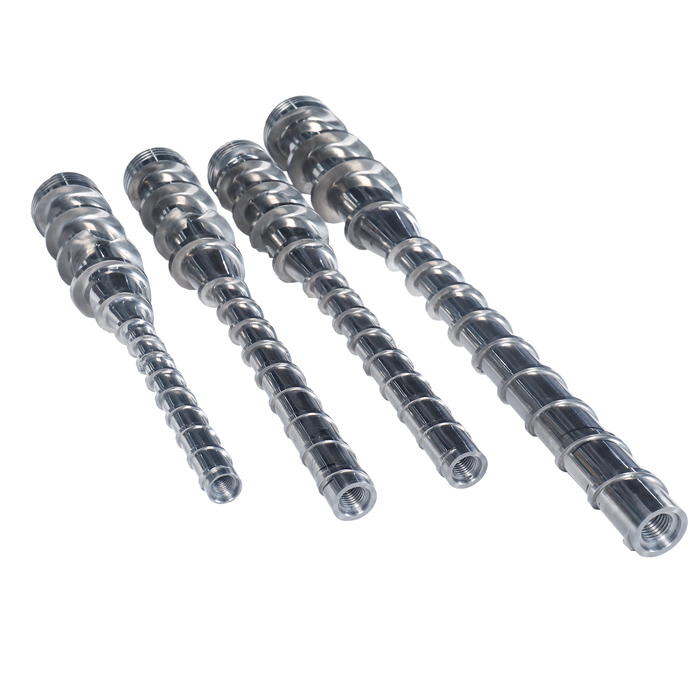
Core Maintenance Practices for Rubber Screw Barrel Systems
| Maintenance Activity | Frequency | Key Benefit |
|---|---|---|
| Visual inspection for surface pitting | Daily | Early detection of localized wear |
| Hardness testing of barrel inner wall | Monthly | Assess remaining wear resistance |
| Screw pull-out cleaning | Every 500-800 running hours | Remove degraded rubber deposits |
| Clearance measurement (screw to barrel) | Quarterly | Prevent melt leakage and backflow |
| Thermocouple calibration | Every 6 months | Ensure accurate barrel zone temperatures |
Beyond scheduled tasks, operators must monitor discharge pressure and motor current. A sudden drop in output with constant screw speed often signals internal wear in the Rubber Screw Barrel pair. EJS recommends recording baseline values for new components and comparing readings monthly.
Advanced Lubrication and Cleaning Protocols
For high-viscosity rubber compounds, proper lubrication of the screw shank and thrust bearings reduces torsional stress on the Rubber Screw Barrel assembly. Use food-grade or rubber-compatible anti-seize compounds on threaded sections. When purging, avoid abrasive cleaning agents—instead, use low-viscosity purging compounds followed by a soft brass scraper. EJS provides customized cleaning tool kits that prevent scratching of hardened barrel bores.
Three Essential FAQs About Rubber Screw Barrel Maintenance
Question 1: How often should the screw be removed from the barrel for full cleaning in a Rubber Screw Barrel system?
Answer: For most rubber extrusion lines, screw extraction should occur every 500 to 800 operational hours. However, if processing carbon-black-filled or halogenated rubber compounds, reduce the interval to 300 hours. EJS recommends documenting the condition of the Rubber Screw Barrel after each pull-out, including photos of the flight tips and barrel inner surface. Delaying full cleaning accelerates abrasive wear and can lead to screw seizure inside the barrel.
Question 2: What is the ideal clearance limit for a worn Rubber Screw Barrel before replacement is necessary?
Answer: The maximum allowable radial clearance depends on the screw diameter. As a rule of thumb, when the gap exceeds 0.3% to 0.5% of the screw diameter, replacement or reconditioning should be planned. For example, a 150 mm diameter Rubber Screw Barrel should have no more than 0.45–0.75 mm clearance. Beyond this limit, melt backflow reduces output by up to 20% and increases shear heat, degrading rubber quality. EJS offers precision re-boring and hard-chrome plating services to restore clearances without full replacement.
Question 3: Can hard chrome plating of the barrel extend the life of a Rubber Screw Barrel after significant wear has occurred?
Answer: Yes, but only if the wear is uniform and the bore remains round within 0.05 mm. Hard chrome plating adds 0.08–0.12 mm of wear-resistant layer and can double the remaining service life. However, if the screw flight tips are also damaged, EJS recommends grinding the screw to match the new plated barrel bore. For severely ovalized barrels, thermal spray coating (e.g., tungsten carbide) is a superior option. Always consult the original Rubber Screw Barrel specifications before applying any coating.
Performance Monitoring Checklist
-
Weekly: Log motor amperage and melt temperature profile
-
Monthly: Measure barrel external temperature uniformity with an infrared camera
-
Quarterly: Perform a "drop weight" output test at constant screw speed
-
Annually: Send a wear report to EJS for predictive maintenance planning
Contact Us
Extend the productive life of your Rubber Screw Barrel systems with expert support from EJS. Our engineering team provides on-site clearance measurement, reconditioning services, and custom replacement screws built to your original drawings. Contact us today for a free wear assessment and maintenance schedule tailored to your rubber production line.