

What Are the Key Advantages of BOPET Metallized Film Over Plain PET in Food Packaging
2026-09-08
When selecting flexible packaging materials for food products, packaging engineers and brand owners often weigh the performance differences between plain PET and its metallized counterpart. While both belong to the polyester family, BOPET Metallized Film For PET food packaging offers distinct functional benefits that directly impact product protection, cost efficiency, and sustainability. At Jincheng, we have observed a decisive shift toward metallized structures across dry snacks, confectionery, coffee, and baked goods—driven by measurable advantages that go far beyond aesthetics.
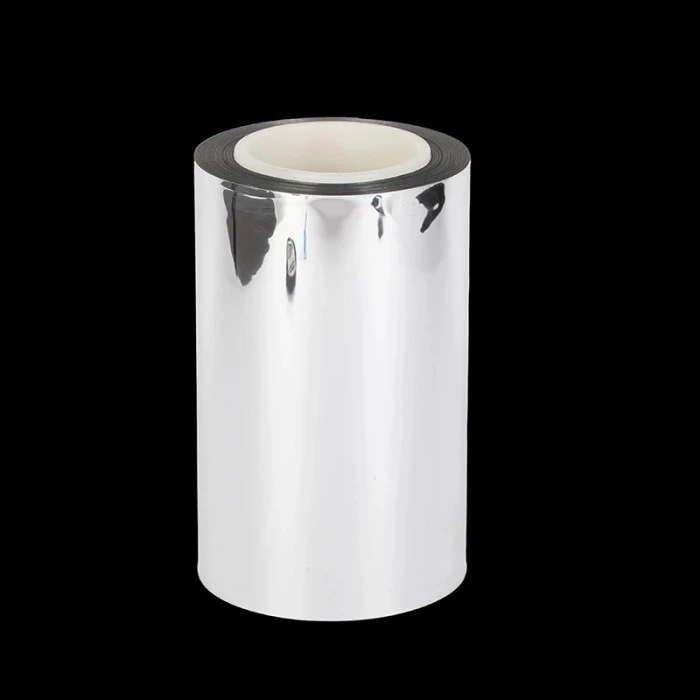
1. Oxygen and Moisture Barrier: The Performance Gap
The most critical difference lies in barrier performance. Plain PET typically delivers an oxygen transmission rate (OTR) of 50–100 cm³/m²/day and a water vapour transmission rate (WVTR) of 10–30 g/m²/day (at 38°C, 90% RH). In contrast, BOPET Metallized Film For PET food packaging reduces OTR to 1–5 cm³/m²/day and WVTR to 1–5 g/m²/day—a 10‑ to 20‑fold improvement.
| Property | Plain PET | BOPET Metallized Film (Al-coated) |
|---|---|---|
| Oxygen Barrier (OTR) | 50–100 cm³/m²/day | 1–5 cm³/m²/day |
| Moisture Barrier (WVTR) | 10–30 g/m²/day | 1–5 g/m²/day |
| Light Transmission | >88% | <2% (opaque) |
| Aroma Retention | Moderate | Excellent |
This superior barrier directly translates into extended shelf life—critical for high-fat or hygroscopic products like nuts, biscuits, and protein bars. For brand owners, this means fewer returns, broader geographic distribution, and reduced need for synthetic preservatives.
2. Light and UV Protection: Preserving Sensory Quality
Plain PET allows nearly full visible and UV light transmission, which accelerates lipid oxidation, chlorophyll degradation, and vitamin loss. BOPET Metallized Film For PET food packaging reflects 95–98% of incident light and UV radiation, effectively creating a "cold mirror" effect. This preserves natural colours, flavours, and nutritional profiles—particularly valuable for products containing natural pigments (e.g., paprika, turmeric) or unsaturated fats.
At Jincheng, we engineer metallized films with uniform aluminium deposition (optical density 2.0–2.4) to ensure consistent light blocking across the entire roll, minimising pinhole risks that compromise protection.
3. Mechanical Strength and Machinability
While both films share similar tensile strength (200–250 MPa), BOPET Metallized Film For PET food packaging exhibits higher modulus and better dimensional stability under heat and tension. This translates to:
-
Less stretching on high-speed form-fill-seal (FFS) lines
-
Better registration for gravure and flexo printing
-
Improved puncture resistance against sharp product edges (e.g., granola, pasta)
For converters, this means fewer web breaks, lower scrap rates, and consistent lamination with other substrates like PE sealant layers. Jincheng provides metallized films with tailored surface roughness (Ra 0.05–0.12 µm) to optimise winding and slitting efficiency.
4. Cost-Effectiveness vs. Aluminium Foil Laminates
Many assume aluminium foil (Alu) is the gold standard, but BOPET Metallized Film For PET food packaging offers a compelling value proposition:
| Factor | Alu Foil Laminate | BOPET Metallized Film |
|---|---|---|
| Material cost | High | 40–60% lower |
| Thickness | 20–30 µm (foil) + PET | 10–12 µm (total) |
| Dead-fold property | Excellent | Moderate |
| Recyclability | Difficult (mixed materials) | Mono-material compatible |
| Pinhole resistance | Lower (bending fatigue) | Higher |
For products requiring moderate barrier (6–12 months shelf life), metallized film often outperforms foil in real-world logistics due to its superior flex-crack resistance. Jincheng recommends metallized PET as a drop-in replacement that reduces packaging weight by up to 30% while maintaining machinability.
5. Sustainability and Recyclability
With tightening regulations on single-use plastics, BOPET Metallized Film For PET food packaging offers a clear path forward. Unlike metalized polypropylene or foil laminates, metallized PET can be designed as a mono-material structure (PET/MET-PET/PE) that is compatible with existing PET recycling streams. At Jincheng, our metallized films achieve <3% aluminium content by weight, allowing recyclers to separate the coating during alkali washing—yielding high-purity PET regrind suitable for secondary applications.
FAQ – BOPET Metallized Film For PET Food Packaging
Q1: Can BOPET metallized film be used directly as a monolayer packaging, or does it always require lamination?
A: BOPET Metallized Film For PET food packaging is rarely used as a monolayer because the aluminium coating, while excellent as a barrier, lacks heat-sealability and has limited puncture resistance on its own. In practice, it is almost always laminated to a sealant layer—typically LDPE, LLDPE, or cast PP—to form a duplex or triplex structure. The PET side serves as the outer web (providing strength, printability, and barrier), while the sealant layer ensures hermetic closure. For retort or boil-in-bag applications, a polypropylene-based sealant with higher temperature resistance is preferred. Jincheng offers pre-laminated structures with tailored adhesive systems (solvent-free or water-based) to match specific filling temperatures and line speeds.
Q2: Does metallization affect the printability or adhesive bonding of the film?
A: Yes, but the effect is fully manageable with proper surface treatment. The aluminium-coated side of BOPET Metallized Film For PET food packaging has a very low surface energy (≈38 dynes/cm), making it unsuitable for direct printing or adhesive lamination. Therefore, printing is always performed on the unmetallized PET surface, which is corona-treated to 50–54 dynes/cm for excellent ink anchorage. For reverse printing (used in laminated structures), the ink layer is sandwiched between the PET and the sealant, protecting it from abrasion and migration. Jincheng provides films with primer coatings or adhesion-promoting layers that ensure bond strengths >4.5 N/15mm with common polyurethane adhesives—even under high-humidity storage conditions.
Q3: How does the shelf life of products packaged with BOPET metallized film compare to those using plain PET?
A: The shelf-life extension is substantial and product-dependent. For example, roasted peanuts stored at 25°C/60% RH have an oxidative rancidity threshold (peroxide value >10 meq/kg) reached in 3–4 months with plain PET, but extended to 12–14 months with BOPET Metallized Film For PET food packaging. For moisture-sensitive products like crackers, plain PET permits moisture ingress that causes staling within 6–8 weeks, whereas metallized film maintains crispness for over 9 months. The actual gain depends on the initial product moisture, storage temperature fluctuations, and the oxygen scavenging capability of the entire laminate. Jincheng conducts accelerated shelf-life testing (ASTM F1980) for each customer application to provide guaranteed performance data before production.
Conclusion
The advantages of BOPET Metallized Film For PET food packaging over plain PET are not marginal—they are transformative across barrier performance, light protection, mechanical reliability, cost structure, and end‑of‑life recyclability. For brands seeking to differentiate through fresher products, lighter packaging, and lower carbon footprints, this material represents a proven, scalable solution.
Jincheng has been a dedicated converter of high-performance metallized films since 2008, supplying to over 40 countries with ISO 9001 and BRCGS certification. Our technical team provides customised optical density, surface treatment, and lamination solutions tailored to your filling equipment and shelf-life targets.
Ready to evaluate BOPET metallized film for your next food packaging project?
Contact Jincheng today at [email protected] or visit our technical service portal to request samples, datasheets, and pilot‑line trial support. Let us help you make the switch—with data, not guesswork.