

How Does the Thermal Expansion of Torlon Tubes Affect Precision Assembly
2026-04-27
When engineers evaluate Torlon Tubes for high-precision mechanical systems, one critical factor often determines success or failure: thermal expansion. Unlike metals or semi-crystalline polymers, Torlon Tubes made from polyamide-imide exhibit a unique thermal behavior that directly influences dimensional stability during assembly. For companies like Guangzhou Ideal, which specializes in high-performance polymer components, understanding this property is essential to ensure tight tolerances in applications ranging from aerospace valves to semiconductor manufacturing equipment.
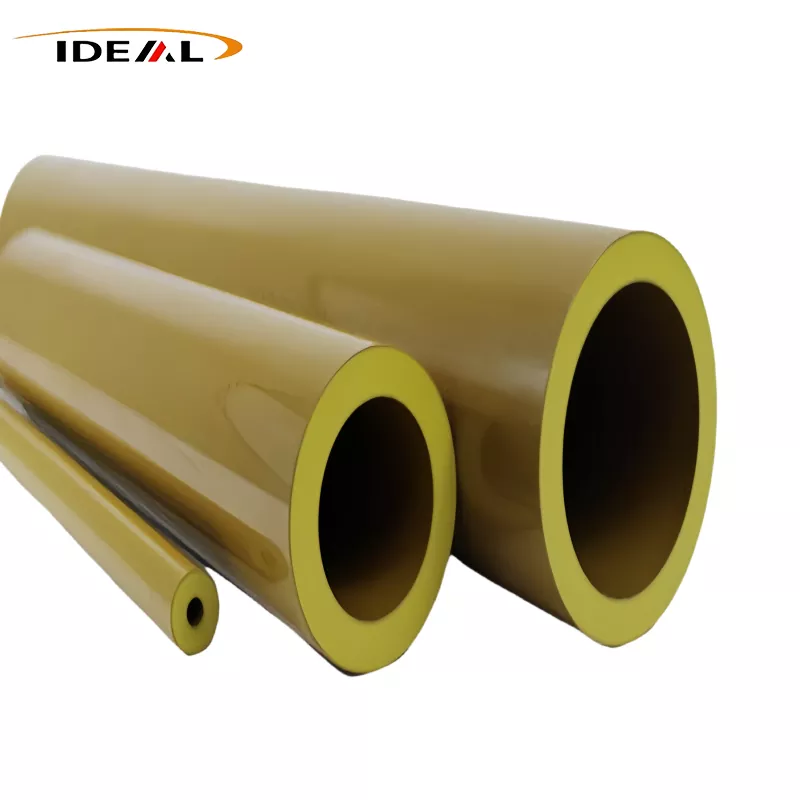
The Thermal Expansion Characteristics of Torlon Tubes
Torlon Tubes have a coefficient of linear thermal expansion (CLTE) ranging from 20 to 30 ppm/°C (depending on grade and orientation), which is significantly higher than steel (about 12 ppm/°C) but lower than many other engineering plastics. This means that during assembly processes involving temperature changes—such as press-fitting, curing adhesives, or operating in fluctuating environments—the tube dimensions change non-linearly.
| Material | CLTE (ppm/°C) | Relative Dimensional Change (per 100°C for 100mm) |
|---|---|---|
| Steel | 12 | 0.12 mm |
| Torlon Tubes | 25 (average) | 0.25 mm |
| PEEK | 47 | 0.47 mm |
| Aluminum | 23 | 0.23 mm |
This 0.25 mm change over a 100 mm length at a 100°C shift might seem minor, but in assemblies with micron-level tolerances, it is significant. Guangzhou Ideal recommends compensating for this expansion by designing interference fits at the assembly temperature rather than room temperature.
Effects on Press-Fit and Interference Assemblies
In precision assemblies where Torlon Tubes are inserted into metal housings, thermal expansion mismatch creates two risks:
-
If assembled at room temperature: When the system heats up during operation, the Torlon Tube expands more than the metal housing, potentially causing buckling or excessive radial stress.
-
If assembled at high temperature: The tube may contract upon cooling, leading to loosening of the fit.
To mitigate this, Guangzhou Ideal engineers often specify a calculated clearance that accounts for the maximum expected operating temperature minus the assembly temperature, multiplied by the CLTE difference between materials.
FAQ: Common Questions About Torlon Tubes and Thermal Expansion
Q1: Can Torlon Tubes be used in applications with rapid temperature cycling without losing precision assembly tolerances?
A1: Yes, but with design precautions. Torlon Tubes have relatively low thermal conductivity (0.26 W/m·K), meaning temperature gradients can develop across the tube wall. Under rapid cycling (e.g., from 25°C to 150°C in 30 seconds), the outer surface expands faster than the inner wall, generating temporary hoop stresses. Guangzhou Ideal recommends limiting temperature change rates to less than 5°C per minute for assemblies with interference fits. For faster cycles, use a stepped assembly design or incorporate compliant intermediate layers such as thin PTFE sleeves.
Q2: How does the anisotropic thermal expansion of extruded Torlon Tubes affect precision assembly compared to machined tubes?
A2: Extruded Torlon Tubes exhibit higher thermal expansion in the axial direction (flow direction) than radially—typically 30 ppm/°C axially vs. 20 ppm/°C radially. Machined Torlon Tubes from compression-molded rod stock have nearly isotropic expansion (23–25 ppm/°C in all directions). For press-fit assemblies where radial clearance is critical, extruded tubes may loosen less than machined ones during heating if the housing expands similarly. Guangzhou Ideal advises specifying the manufacturing method in your assembly drawing because axial expansion differences affect bolt preload retention in flange-mounted tube assemblies.
Q3: What is the maximum temperature range over which Torlon Tubes can maintain interference fit integrity without creep-induced failure?
A3: Torlon Tubes retain good creep resistance up to 200°C (short-term) and 180°C continuously. However, thermal expansion combined with creep becomes significant above 150°C. For an interference fit of 0.05% of diameter (e.g., 0.05 mm on a 100 mm diameter tube), the assembly remains stable from -40°C to +150°C. Beyond 150°C, stress relaxation due to polymer chain mobility reduces interference pressure by up to 30% after 1000 hours. Guangzhou Ideal recommends performing a creep-relaxation calculation using the Larson-Miller parameter for assemblies exceeding 150°C. For such conditions, reduce initial interference to 0.03% and add mechanical retention like retaining rings.
Best Practices for Precision Assembly
To successfully integrate Torlon Tubes into precision systems, Guangzhou Ideal advises the following:
-
Always specify the assembly temperature on engineering drawings.
-
Perform FEA simulations that include both thermal expansion and viscoelastic creep.
-
Use tapered lead-ins on mating parts to avoid edge stress during temperature changes.
For custom-sized Torlon Tubes with matched thermal expansion profiles, Guangzhou Ideal provides pre-assembly conditioning services where tubes are heat-soaked at the expected operating temperature before final measurement.
Contact Us
If your precision assembly requires reliable performance from Torlon Tubes in thermally challenging environments, Guangzhou Ideal offers engineering support, custom tube sizing, and thermal expansion modeling for your specific application. Contact us today with your design parameters to receive a detailed fit analysis and sample testing proposal.