

How Does PRIMOSPIRE SRP Achieve Strength Without Reinforcement?
2026-09-22
In lightweight design, the conventional path to strength is reinforcement. Glass fibers, carbon fibers, and mineral fillers are added to a polymer matrix to increase stiffness and tensile strength. But reinforcement introduces trade-offs: anisotropic properties, increased weight, reduced ductility, and processing complexity. PRIMOSPIRE SRP (Self-Reinforced Polyphenylene) takes a fundamentally different approach. It achieves mechanical performance comparable to reinforced plastics without any added reinforcement. The strength comes from the molecular architecture of the polymer itself. This guide explains how that architecture works, what properties it delivers, and where the material fits in a design engineer's toolbox.
1. What Is the Fundamental Limitation of Fiber-Reinforced Thermoplastics?
Fiber-reinforced thermoplastics achieve their strength through the load-transfer mechanism between the polymer matrix and the reinforcing fibers. The fibers carry the tensile load, and the matrix transfers stress between fibers. This mechanism works well, but it introduces four limitations. The first is anisotropy. The fibers orient during processing, which means the material is strong in the flow direction but weaker in the transverse direction. Engineers must account for this directional difference in their designs. The second is weight. Glass fibers have a specific gravity of 2.5, and carbon fibers have a specific gravity of 1.8. Adding them to a polymer increases the density. The third is reduced ductility. Reinforced plastics are stiffer but more brittle than their unfilled counterparts. The fourth is processing complexity. Fibers can break during injection molding, and the orientation is difficult to control precisely. The table below compares the key trade-offs of reinforced and self-reinforced approaches.
| Design consideration | Glass-filled thermoplastic (30% GF) | PRIMOSPIRE SRP (unfilled) |
| Specific gravity | 1.3 – 1.5 | 1.19 – 1.24 |
| Mechanical isotropy | Anisotropic (flow-dependent) | Isotropic (uniform in all directions) |
| Ductility | Low (brittle) | Moderate (retains some elongation) |
| Surface finish | Fibers may protrude | High gloss, scratch resistant |
| Processing | Fiber breakage, wear on tooling | Standard melt processing |
Shanghai Visa Plastics S&T Co., Ltd. supplies PRIMOSPIRE SRP in multiple grades for compression molding, injection molding, and extrusion. Our factory provides material data and processing guidance for engineers evaluating the material for structural applications.
2. What Molecular Structure Enables Self-Reinforcement in PRIMOSPIRE SRP?
The self-reinforcing property of PRIMOSPIRE SRP comes from its rigid-rod molecular structure. Conventional polymers have a flexible backbone that allows the chains to coil and entangle. These coils provide some mechanical strength through entanglement, but the backbone also contains connecting groups—esters, amides, or ethers—that act as weak points under stress. PRIMOSPIRE SRP is a true polyphenylene. Its backbone consists entirely of phenylene units connected directly to each other, with no intervening flexible or weak linking groups. This structure produces a molecule that is inherently rigid and rod-like. When these rigid rods pack together in the solid state, they create a self-reinforcing network without the need for added fibers. The rigidity of the individual molecules translates directly into the stiffness and strength of the bulk material. The table below compares the molecular characteristics and resulting properties of PRIMOSPIRE SRP with a conventional engineering thermoplastic.
| Molecular / material characteristic | Conventional polycarbonate (PC) | PRIMOSPIRE SRP |
| Backbone structure | Flexible with carbonate linking groups | Rigid-rod, phenylene-only backbone |
| Tensile strength (MPa) | 60 – 70 | 115 – 207 (grade dependent) |
| Tensile modulus (GPa) | 2.3 – 2.4 | 3.9 – 8.3 (grade dependent) |
| Heat deflection temperature (°C) | 130 – 140 | 154 – 171 |
| Limiting oxygen index (%) | 25 – 27 | 49 (inherently flame retardant) |
The rigid-rod structure also explains the material's inherent flame retardancy. The limiting oxygen index of 49 percent is significantly higher than conventional thermoplastics, which means the material requires a much higher oxygen concentration to sustain combustion. This is achieved without adding halogenated flame retardants.
3. What Mechanical Properties Does PRIMOSPIRE SRP Deliver Without Reinforcement?
The mechanical properties of PRIMOSPIRE SRP vary by grade, but the highest-performance grades deliver tensile strength of 207 MPa and flexural modulus of 8.3 GPa without any fiber reinforcement. These values are comparable to or exceed many glass-filled engineering plastics. The material also retains its properties at low temperatures, which is unusual for amorphous polymers. The table below summarizes the typical properties of the main commercial grades.
| Property | PR-120 (structural grade) | PR-250 (injection grade) | PR-351 (high flow grade) |
| Tensile strength (MPa) | 207 | 152 | 115 |
| Tensile modulus (GPa) | 8.3 | 5.5 | 3.9 |
| Flexural modulus (GPa) | 8.3 | 6.0 | 4.0 |
| Notched Izod (J/m) | 43 | 59 | 69 |
| Heat deflection temp. (°C) | 154 | 151 | 171 |
The specific strength of PRIMOSPIRE SRP—tensile strength divided by density—exceeds many common structural materials. For a design engineer, this means that a component can be made lighter without sacrificing load-bearing capacity. The isotropic properties also simplify design calculations, because the engineer does not need to account for fiber orientation effects.
4. What Applications Benefit Most From Self-Reinforced Polyphenylene?
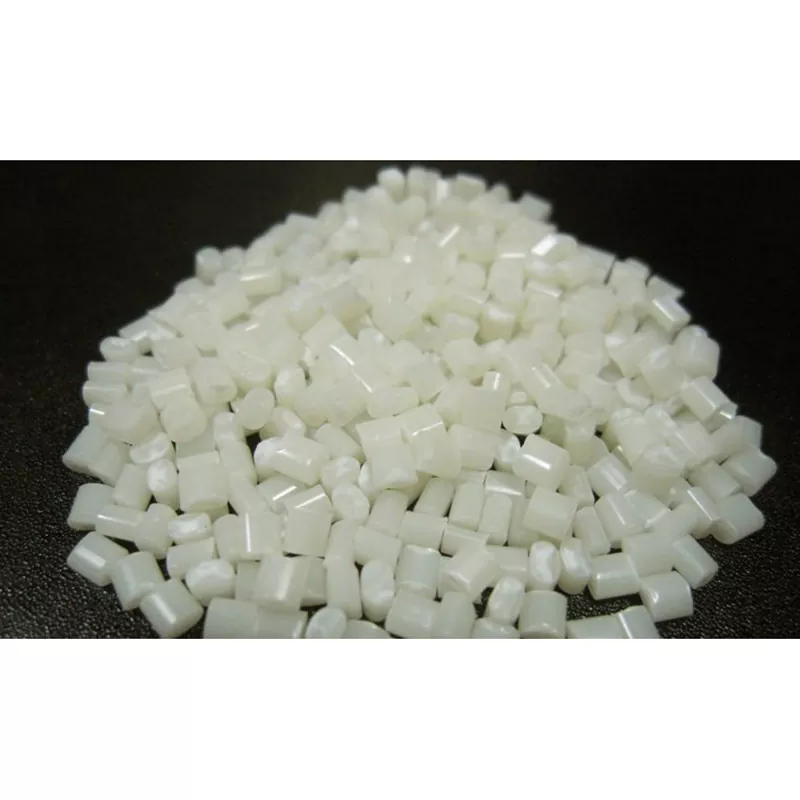
PRIMOSPIRE SRP is best suited for applications where weight reduction, isotropic strength, and resistance to chemicals or high temperatures are priorities. The material is used in aircraft substructures, semiconductor components, medical tubing, bushings, bearings, and gears. In each case, the design benefits from the combination of high strength and low weight without the processing complexity of reinforced plastics. For example, a gear made from PRIMOSPIRE SRP can replace a metal gear with a weight reduction of 70 to 80 percent while maintaining tooth strength and wear resistance. A semiconductor component benefits from the material's low outgassing and chemical resistance. Visa Plastics provides PRIMOSPIRE SRP in pellet and powder form, and our factory can advise on the appropriate grade for specific applications.
Frequently Asked Questions About PRIMOSPIRE SRP Without Reinforcement
Summary for Materials Engineers
PRIMOSPIRE SRP achieves strength without reinforcement through its rigid-rod polyphenylene molecular structure. The phenylene-only backbone eliminates the weak linking groups that limit the performance of conventional polymers. The resulting material delivers tensile strength up to 207 MPa and flexural modulus up to 8.3 GPa without added fibers. The isotropic properties, low density, high temperature resistance, and inherent flame retardancy make it suitable for weight-sensitive structural applications in aerospace, medical, and semiconductor industries. Shanghai Visa Plastics S&T Co., Ltd. supplies PRIMOSPIRE SRP in multiple grades and provides technical support for material selection and processing.
Shanghai Visa Plastics S&T Co., Ltd. is a China-based supplier of PRIMOSPIRE SRP for compression molding, injection molding, and extrusion. We provide material data sheets and processing guidance for all grades.