

How Does Moisture Absorption Affect the Dimensional Stability of Torlon Rods Over Time
2026-05-25
Torlon rods are widely recognized for their exceptional mechanical strength, thermal resistance, and chemical inertness. However, one frequently overlooked factor that can influence their long-term performance is moisture absorption. For engineers and procurement specialists relying on Torlon rods from Guangzhou Ideal, understanding how humidity affects dimensional stability is critical for precision applications.
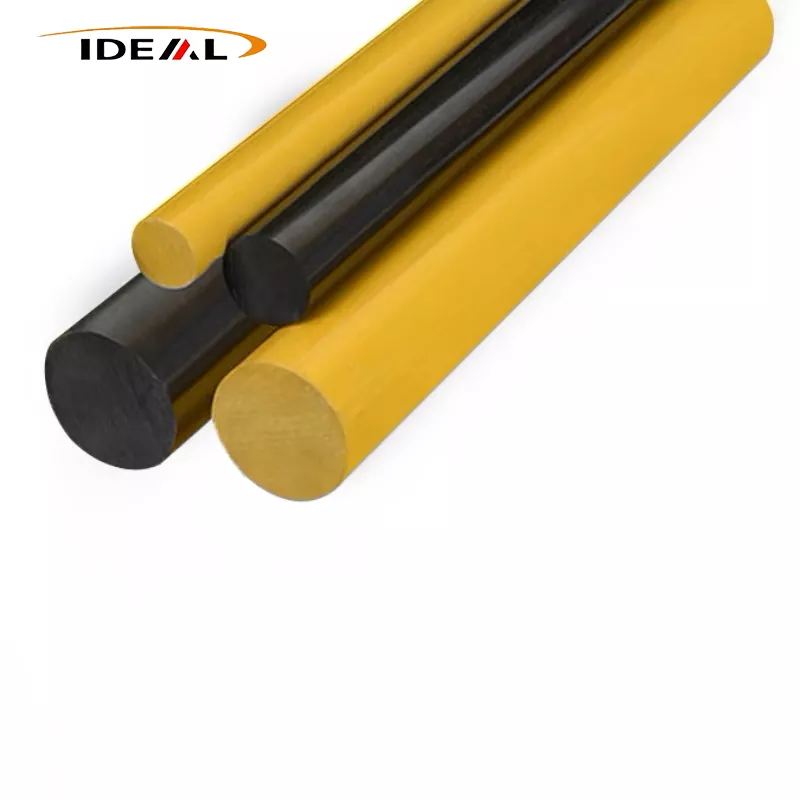
The Science Behind Moisture Absorption in Torlon Rods
Torlon rods are polyamide-imide (PAI) based materials. Unlike commodity plastics, PAI absorbs moisture gradually when exposed to humid environments. This absorption occurs primarily in the amorphous regions of the polymer matrix. Over time, moisture acts as a plasticizer, leading to slight swelling. The dimensional change is typically anisotropic, meaning it varies along different axes due to molecular orientation during extrusion or molding.
| Exposure Condition | Typical Moisture Uptake (by weight) | Resulting Dimensional Change (per 100mm) |
|---|---|---|
| 23°C / 50% RH (controlled) | 1.2 – 1.5% | +0.05 – 0.08 mm |
| 23°C / 85% RH (high humidity) | 2.0 – 2.5% | +0.10 – 0.15 mm |
| Immersion in water (24 hours) | 3.0 – 3.5% | +0.18 – 0.25 mm |
| Cyclic humidity (40-90% RH) | Variable up to 2.8% | Irregular expansion up to 0.12 mm |
Long-Term Dimensional Stability
For components machined from Torlon rods, even micrometre-level swelling can cause fit issues in bearings, valve seats, or electrical housings. Guangzhou Ideal recommends conditioning Torlon rods at 23°C and 50% RH for 48 hours before final machining. This pre-conditioning step simulates normal atmospheric exposure, allowing the material to reach a near-equilibrium moisture content. Once equilibrated, Torlon rods exhibit predictable reversible expansion below 0.1% per year under stable humidity.
Torlon Rods FAQ Common Questions
Question 1: Can Torlon rods return to their original dimensions after drying out following moisture absorption?
Answer: Yes, partially. When Torlon rods are dried at elevated temperatures (150°C for 4 hours), absorbed moisture diffuses out, and the rods typically recover 90-95% of their original dimensions. However, repeated cycling between wet and dry states may cause residual micro-stress and minor irreversible growth of approximately 0.02-0.03% over multiple cycles. For high-precision applications, Guangzhou Ideal recommends maintaining consistent environmental conditions rather than relying on post-drying recovery.
Question 2: How does the moisture-induced swelling of Torlon rods compare to other high-performance plastics like PEEK or Vespel?
Answer: Torlon rods absorb more moisture than PEEK (0.5% max) but less than Vespel (up to 3.5%). Under identical 85% RH conditions, Torlon rods expand roughly 0.12 mm/m, while PEEK expands 0.04 mm/m and Vespel expands 0.18 mm/m. However, Torlon rods offer superior compressive strength and creep resistance even after moisture uptake, making them preferable for load-bearing parts where slight swelling is tolerable. Guangzhou Ideal provides comparative data sheets upon request.
Question 3: What machining allowances should be made to accommodate dimensional changes from moisture in Torlon rods?
Answer: For components that will operate in uncontrolled humidity (30-80% RH), Guangzhou Ideal advises adding +0.1 to +0.15 mm of clearance per 100 mm of nominal dimension. For example, a 50 mm diameter bearing from Torlon rods should be machined to 49.90 mm if a 50 mm metal housing fit is required. Conversely, for vacuum or dry nitrogen environments (below 10% RH), machine to exact size after pre-drying the rod at 120°C for 12 hours. Always confirm final tolerance with test coupons exposed to actual service humidity.
Practical Recommendations
-
Pre-conditioning: Store Torlon rods at 23°C / 50% RH for 48 hours before machining.
-
Coating options: Apply PTFE or epoxy-based sealants to reduce moisture ingress.
-
Monitoring: Use hygrometers and gauge blocks to track part dimensions over time.
Contact Us
For expert guidance on selecting the right grade of Torlon rods for your humid or dimension-sensitive environment, reach out to Guangzhou Ideal today. Visit our product page or email our engineering support team to request free samples, machining guidelines, and custom sizes. Let us help you optimize your high-performance plastic components with reliable solutions tailored to your application needs.