

How Can Expanded PTFE Sealing Cord Improve Industrial Sealing Performance?
2026-09-22
When industrial equipment operates under demanding conditions, sealing performance directly affects efficiency, safety, maintenance costs, and service life. A sealing material must not only prevent leakage but also adapt to uneven surfaces, temperature changes, chemical exposure, and different equipment structures. Expanded PTFE Sealing Cord has become a practical solution for these requirements because its flexible structure can conform closely to sealing surfaces while maintaining the chemical resistance associated with PTFE. For manufacturers and industrial buyers looking for dependable sealing materials, Ningbo Taifno PTFE Plastic Products Co., Ltd. provides PTFE-based sealing solutions designed for diverse industrial applications, including customized sealing requirements and special-shaped profiles.
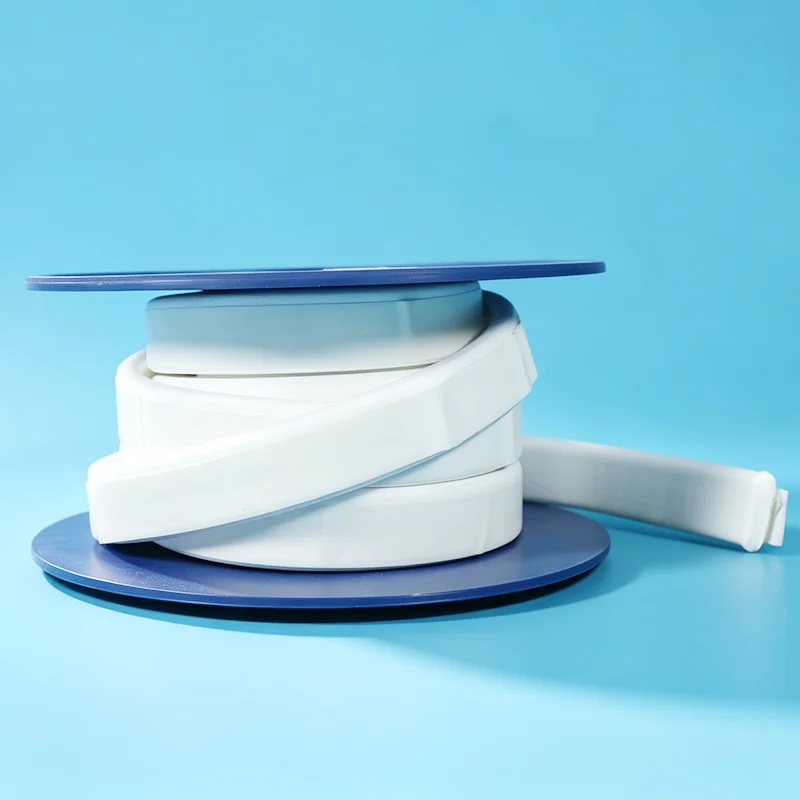
What Makes Expanded PTFE Sealing Cord Different?
Expanded PTFE Sealing Cord is produced from expanded polytetrafluoroethylene, commonly known as ePTFE. During the expansion process, PTFE develops a fibrillated and microporous structure, giving the material a combination of flexibility, compressibility, and mechanical stability. Research and industrial product data indicate that expanded PTFE can provide excellent adaptability to irregular sealing surfaces while retaining the chemical resistance and temperature resistance associated with PTFE.
Compared with conventional rigid PTFE components, the cord format provides greater flexibility during installation. It can be formed along different flange geometries and sealing paths, making it particularly useful where standard pre-cut gaskets are inconvenient or unable to match a specific configuration.
The main performance characteristics include:
-
Excellent chemical resistance
-
High flexibility and compressibility
-
Good adaptability to uneven surfaces
-
Low friction characteristics
-
Good temperature resistance
-
Reliable sealing performance
-
Convenient installation and replacement
-
Availability in customized dimensions and profiles
These characteristics make Expanded PTFE Sealing Cord suitable for industrial equipment where sealing reliability is a long-term requirement.
How Does Expanded PTFE Sealing Cord Improve Sealing Performance?
The primary function of a sealing cord is to fill the microscopic gaps between mating surfaces. When compressed during installation, the flexible ePTFE structure conforms to surface irregularities and creates a continuous sealing barrier.
This adaptability is especially valuable for large, irregular, worn, or non-standard sealing surfaces. Compared with a rigid gasket that must precisely match the flange dimensions, a cord can be positioned according to the actual sealing path.
| Performance Factor | Expanded PTFE Sealing Cord | Conventional Rigid Gasket |
|---|---|---|
| Surface adaptability | Excellent | Depends on gasket geometry |
| Irregular shapes | Highly suitable | May require special fabrication |
| Installation flexibility | High | Relatively limited |
| Chemical resistance | Excellent | Depends on material |
| Custom profiles | Available | Usually requires tooling |
| Maintenance replacement | Convenient | Requires matching gasket |
The result can be a more practical sealing process, particularly for equipment requiring frequent maintenance or customized sealing dimensions.
Why Is It Important for Industrial Applications?
A sealing failure can lead to fluid leakage, contamination, equipment downtime, maintenance expenses, and even production interruptions. Therefore, choosing a suitable sealing material is not simply a component-level decision; it can influence the overall operating reliability of industrial equipment.
Expanded PTFE Sealing Cord is especially valuable in applications involving aggressive chemicals, water, gases, solvents, and other demanding media. Many commercial ePTFE products are designed for broad chemical resistance and wide operating temperature ranges, although the actual pressure and temperature limits should always be evaluated according to the specific grade and installation conditions.
Its importance can be summarized in four areas:
-
Leakage control – The flexible material can conform closely to sealing surfaces.
-
Equipment protection – Reliable sealing helps reduce exposure to unwanted fluid leakage.
-
Maintenance efficiency – Cord can be installed along the required sealing route without requiring a separately fabricated gasket for every configuration.
-
Application flexibility – Different dimensions and profiles can accommodate a wider range of industrial equipment.
Where Can Expanded PTFE Sealing Cord Be Used?
Expanded PTFE Sealing Cord can be used in various industrial sealing applications. Typical applications include flanges, valves, pumps, tanks, vessels, pipe connections, equipment housings, and other static or low-movement sealing structures.
Typical industries include:
-
Chemical processing
-
Pharmaceutical equipment
-
Food processing
-
Petrochemical systems
-
Industrial machinery
-
Water treatment
-
Energy equipment
-
Fluid handling systems
-
Customized mechanical equipment
For large flanges or sealing surfaces with unusual dimensions, cord-based sealing can reduce the need to maintain numerous individual gasket sizes. The material can be shaped along the actual sealing path, which can also simplify inventory management and maintenance.
How Does Customization Add More Value?
Not every sealing application uses a standard circular, rectangular, or straight profile. Specialized equipment may require sealing components with unusual geometries to match the structure of the sealing surface.
This is where customization becomes an important advantage.
Ningbo Taifno PTFE Plastic Products Co., Ltd. can support customized PTFE sealing solutions according to application requirements, dimensions, shape, and sealing structure. In addition to conventional profiles, boat-shaped customization is supported, providing an option for applications where a boat-shaped sealing profile or special contour is required.
Customization Capabilities
-
Custom dimensions
-
Custom cross-sectional profiles
-
Custom length
-
Special-shaped sealing designs
-
Boat-shaped customization
-
Application-specific sealing configurations
-
OEM requirements
-
Bulk production for industrial buyers
Boat-shaped customization can be particularly useful when the sealing surface contains a special contour that cannot be efficiently covered by a standard straight or round sealing cord. By matching the profile more closely to the equipment structure, customized sealing components can help improve installation convenience and application compatibility.
For B2B buyers, this also means that the purchasing process can move beyond simply selecting a standard product size. Instead, the sealing solution can be developed around the actual equipment requirements.
What Should Buyers Consider When Selecting the Cord?
Selecting the correct Expanded PTFE Sealing Cord requires more than checking the material name. The sealing environment, geometry, compression conditions, and operating media should all be considered.
Important factors include:
| Selection Factor | Key Consideration |
|---|---|
| Sealing surface | Flat, irregular, grooved, or special-shaped |
| Cord dimension | Diameter or cross-sectional size |
| Medium | Chemical, gas, water, solvent, etc. |
| Temperature | Continuous and short-term operating temperature |
| Pressure | System pressure and installation conditions |
| Equipment structure | Standard or customized geometry |
| Installation | Manual, groove-mounted, or specially positioned |
| Customization | Standard, OEM, or boat-shaped profile |
Buyers should also distinguish between material capability and actual application performance. Temperature and pressure ratings are not universal values for every ePTFE product, and they may depend on installation conditions, dimensions, compression, and the specific material grade.
Why Choose Ningbo Taifno PTFE Plastic Products Co., Ltd.?
For industrial buyers, a sealing supplier should provide more than a standard catalog product. Different equipment structures often require different dimensions, shapes, and performance characteristics.
Ningbo Taifno PTFE Plastic Products Co., Ltd. focuses on PTFE plastic products and sealing solutions for industrial applications. Its product approach combines material expertise with customized manufacturing requirements, helping buyers address applications where standard sealing components may not provide the desired fit.
The ability to support custom shapes, including boat-shaped customization, gives customers additional flexibility when developing sealing components for specialized equipment. For OEM manufacturers, equipment manufacturers, distributors, and industrial maintenance suppliers, customized production can also help reduce the limitations associated with standard-size sealing products.
How Can the Right Sealing Cord Reduce Maintenance Pressure?
A sealing solution that matches the application can help simplify installation, replacement, and inventory management. Instead of stocking numerous gasket shapes for different equipment configurations, certain applications can use flexible cord-based sealing materials that can be adapted to the required sealing path.
For maintenance teams, this flexibility can be especially useful when dealing with older equipment, replacement projects, or machinery with non-standard dimensions.
A well-selected Expanded PTFE Sealing Cord can therefore contribute to:
-
More convenient installation
-
Better adaptation to irregular surfaces
-
Reduced dependence on standard gasket dimensions
-
More flexible replacement procedures
-
Improved sealing consistency
-
More efficient customized procurement
Ultimately, the value of a sealing material is measured not only by its material properties but also by how effectively it solves the practical requirements of the equipment.
Conclusion
Expanded PTFE Sealing Cord combines the chemical resistance of PTFE with the flexibility and conformability provided by its expanded structure. These characteristics make it suitable for a broad range of demanding sealing applications involving industrial machinery, valves, pumps, flanges, tanks, and fluid-handling systems.
For buyers requiring more than standard sealing dimensions, customization can provide an additional advantage. Ningbo Taifno PTFE Plastic Products Co., Ltd. supports customized PTFE sealing solutions, including boat-shaped customization, helping customers address special sealing geometries and OEM requirements more efficiently.
If you are looking for Expanded PTFE Sealing Cord with customized dimensions, special profiles, or boat-shaped designs for your industrial application, contact us to discuss your requirements and develop a sealing solution suited to your equipment.