

Can a Plastic Scalloped Large Size Flower Pot Mould Be Customized for Different Flower Pot Designs
2026-10-30
Customization is one of the most common questions buyers raise when sourcing Plastic Scalloped Large Size Flower Pot Mould tooling, and the short answer is yes—within well-defined engineering limits. At ZHONGYUE, customization requests account for a significant share of large-size mould projects, ranging from scallop profile adjustments to full cavity redesigns for new pot collections. This guide explains what can be customized, how the process works, and where practical constraints apply, so you can plan a mould project with realistic expectations.
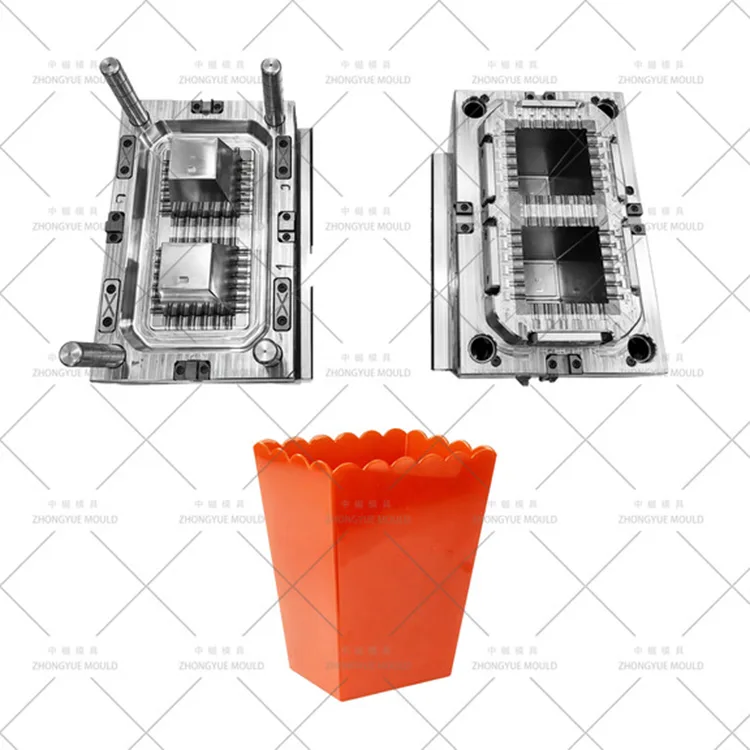
What Can Be Customized in a Plastic Scalloped Large Size Flower Pot Mould?
A Plastic Scalloped Large Size Flower Pot Mould is not a single fixed product. The scalloped edge, pot geometry, wall thickness, drainage configuration, and surface finish can all be engineered to match a specific design. The table below summarizes the main customization dimensions ZHONGYUE supports.
| Customization Item | Options Available | Typical Engineering Consideration |
|---|---|---|
| Scallop profile | Wave count, depth, radius, asymmetric patterns | Draft angle must remain sufficient for demolding |
| Pot size and capacity | Diameter, height, taper ratio | Large-size parts require balanced cooling layout |
| Wall thickness | 2–6 mm depending on resin and load | Thicker walls increase cycle time and clamp force demand |
| Drainage and bottom design | Hole count, hole position, root ribs, feet | Core-side inserts simplify maintenance |
| Surface finish | Matte, glossy, textured, wood-grain | Texture depth affects ejection resistance |
| Material selection | PP, HDPE, ABS, PC, AS | Shrinkage rate determines cavity dimension compensation |
| Cavity quantity | Single cavity to multi-cavity | Multi-cavity tools raise cost but lower unit price |
| Runner system | Cold runner or hot runner | Hot runner suits high-volume production |
How the Customization Process Works at ZHONGYUE
A structured workflow keeps customization predictable and traceable. ZHONGYUE typically follows five stages:
-
Design review – 3D drawings or samples are assessed for draft angles, wall uniformity, and scallop feasibility.
-
Mould flow analysis – simulation validates filling, cooling, and shrinkage before steel is cut.
-
Tooling design – cavity, core, inserts, and ejection systems are finalized with manufacturability notes.
-
Trial and sampling – first-shot samples are measured against the drawing, with adjustments made as needed.
-
Production and handover – process parameters, maintenance guidance, and spare parts documentation are delivered with the tool.
This sequence reduces rework risk and gives buyers clear checkpoints for approval.
Key Factors That Influence Customization Feasibility
Customization is technically open but commercially and physically bounded. The following factors deserve early attention:
-
Draft angle and scallop depth – Deep scallops with near-vertical walls can cause sticking; a minimum draft is required.
-
Wall thickness uniformity – Uneven walls create sink marks and warping in large pots.
-
Shrinkage compensation – Different resins shrink at different rates, so cavity dimensions must be adjusted accordingly.
-
Mould steel and heat treatment – Large moulds benefit from pre-hardened or nitrided steel for longevity.
-
Production volume – High-volume programs justify multi-cavity or hot runner investment; low-volume programs favor simpler tooling.
Frequently Asked Questions
Q: Can the scallop pattern on a Plastic Scalloped Large Size Flower Pot Mould be changed without building a new tool?
A: Partially. If the scallop detail is cut into interchangeable inserts, the pattern can be swapped with moderate cost and downtime. If the scallops are machined directly into the cavity block, a design change generally requires re-machining or a new cavity, so insert-based designs are preferable when pattern variety is expected.
Q: How long does it take to customize a Plastic Scalloped Large Size Flower Pot Mould for a new pot design?
A: A typical custom project runs 35 to 60 days from approved drawings to first samples, depending on part size, cavity count, and design complexity. Multi-cavity tools and hot runner systems sit at the longer end, while single-cavity tools with standard scallop profiles can move faster.
Q: Does customization affect the durability of a Plastic Scalloped Large Size Flower Pot Mould?
A: Durability depends mainly on steel grade, heat treatment, cooling design, and maintenance rather than customization itself. A well-engineered custom tool from ZHONGYUE using suitable mould steel and proper surface treatment can deliver long service life, provided operators follow recommended clamping force and cleaning schedules.
Why Choose ZHONGYUE for Custom Mould Projects
ZHONGYUE combines in-house tooling design, mould flow simulation, and trial sampling under one roof, which shortens communication loops and keeps customization decisions grounded in manufacturability data. Buyers receive dimension reports, sample evaluation support, and maintenance documentation, helping both new and repeat programs stay on schedule.
Contact Us
Ready to customize a Plastic Scalloped Large Size Flower Pot Mould for your next pot design? Send your drawings, target capacity, and estimated annual volume to ZHONGYUE today, and our engineering team will return a feasibility assessment and quotation tailored to your project.